
The trail stretched across borders and time zones – a man had skipped bail in 2021 and fled to Thailand where he became a cybercriminal, hacking into multiple FairPrice and Zalora accounts to make fraudulent purchases.
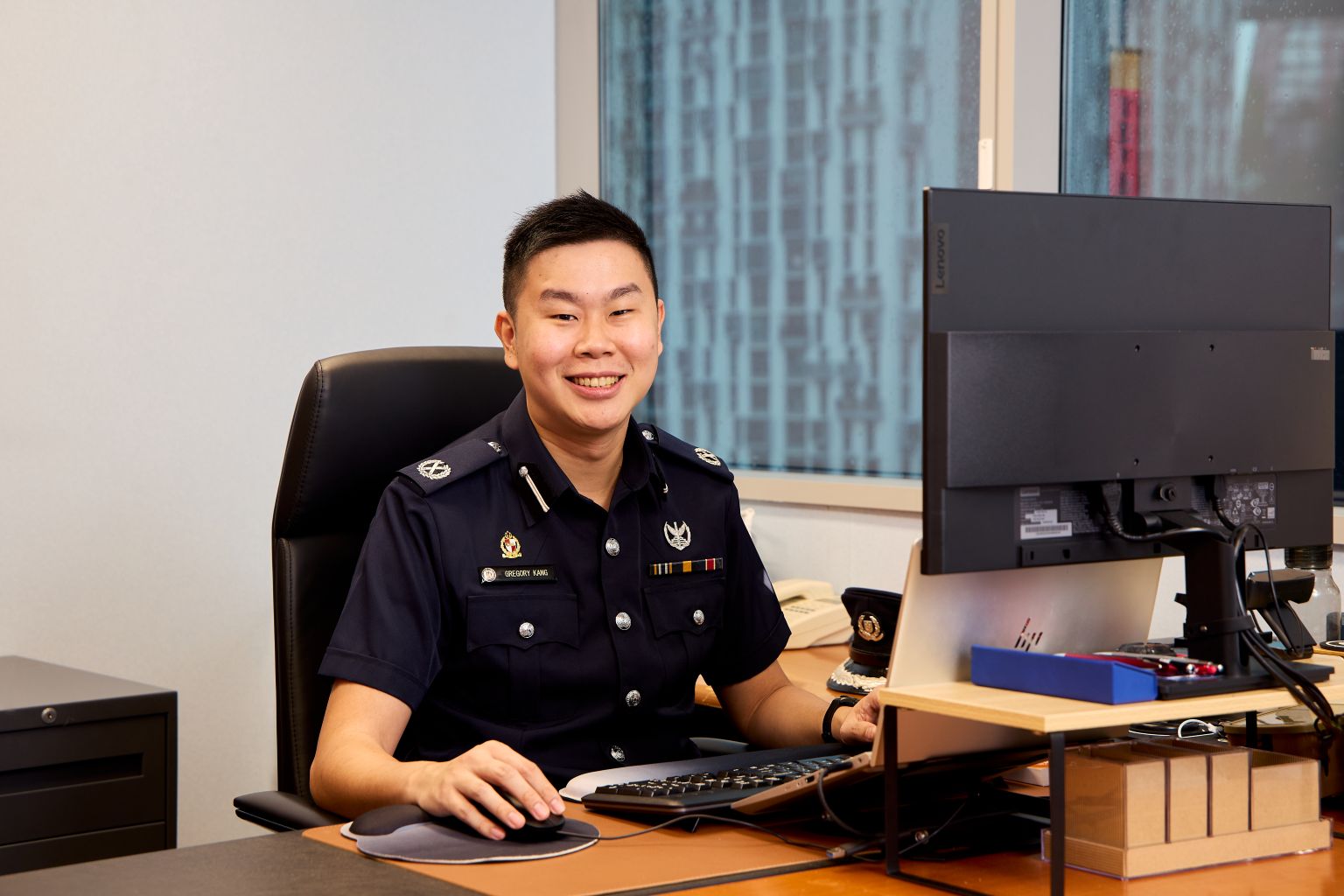
The Singapore Police Force (SPF) worked closely with its foreign counterparts to track him down and he was deported back to Singapore last August. Working closely with fellow officers and leading the Singapore team was Deputy Assistant Commissioner of Police (DAC) Gregory Kang.
The 34-year-old, who is Assistant Director of the SPF’s Criminal Investigation Department (CID) oversees the Cybercrime Division. This division covers cybercrime investigations, policy development, partnerships, international collaboration, and training. His team of Police officers leads investigations into major cybercrime cases and works closely with foreign agencies to bring offenders to justice.
When he graduated in 2015 as a Singapore Merit scholar on the Ministry of Home Affairs (MHA) Uniformed Scholarship (SPF), cybercrime was rapidly emerging as a major threat.
“Cybercrime has become one of the growing threats to law and order. In 2020, cybercrime and scams cases nearly matched physical crime cases for the first time, and today, they are more than double the number of physical crimes cases in Singapore,” says DAC Kang.
Over the years, the SPF’s role has evolved to confront these crimes online and it has worked with other government agencies and the private sector to protect Singaporeans from such invisible threats.
According to SPF’s Mid-Year Scam and Cybercrime Brief 2025, cybercrime and scam cases had decreased by 21.5 per cent to 22,476 cases in the first half of 2025, compared with 28,625 cases in the same period the year before. The results are encouraging, but enforcement cannot ease up.
“The unique thing about cybercrime is that it knows no borders,” says DAC Kang. “The offenders we deal with are often overseas and very well organised. To bring the fight to the cybercriminals, we need to stay ahead and work well with like-minded partners. There is a strong emphasis amongst law enforcement agencies worldwide to collaborate and share information as well as mount operations together so that we can bring criminals to justice.”
This means Police officers now need to be as fluent in cybercrime-fighting techniques, data analysis, financial investigations and cross-border investigations, as they are in traditional methods of inquiry. As such, DAC Kang is spearheading efforts to build a more diverse and skilled cybercrime workforce, bringing in civilian investigators with expertise in artificial intelligence and data science to work alongside uniformed officers.
“Criminals do not stay static, and the SPF is always thinking about how we can evolve our crime-fighting strategies to stay ahead of the bad guys,” he says.
“For example, ransomware tends to target corporations and small and medium enterprises which may not have robust digital security infrastructure. At the same time, with the rise of cryptocurrencies, we are seeing an increasing trend of cybercriminals targeting the individual accounts of cryptocurrency traders. Solving these cases requires officers to be tech-savvy, and be determined to get to the bottom of each case.”
Even as crime patterns shift, the core purpose of policing remains unchanged: keeping people safe.
For DAC Kang, that conviction took root more than a decade ago, when he was a rookie investigator at Bedok Police Division handling a case of voyeurism at a Housing Board flat.
“We identified the suspect, and it took quite a few interviews to elicit his confession,” he recalls. “Getting him to admit to his crime was important because it showed him that we had the tenacity to see the case through, and that made it less likely he would do it again.”
When the victim said she finally felt safe at home again, knowing the perpetrator had been found, her words reinforced DAC Kang’s conviction on the positive impact of police work.
“She was very grateful and said that the apprehension and subsequent prosecution of the suspect gave her the peace of mind to continue living in her flat,” says DAC Kang.
“This really stayed with me. It reminded me why we put in the effort to fight crime and track down criminals – so people can feel safe carrying out their daily activities, whether outside or in their own homes.”
Since joining the SPF in 2011, DAC Kang’s secondments to other government ministries have broadened his understanding of how the public service protects and supports Singaporeans from all walks of life.
After a stint at MHA, he was rotated to the wider public service in 2023 and became a Deputy Director at the Ministry of Social and Family Development’s (MSF) Social Mobility and Service Integration Division. There, he developed policies and oversaw the roll-out of ComLink+, a programme that helps lower-income families with children achieve stability, self-reliance, and social mobility.
Through ComLink+, family coaches from MSF’s Social Service Offices and case workers from Family Service Centres journey with families and support them in working towards their long-term goals.
“I really identified with the meaning and purpose of the job because I had always felt grateful for the hard work and effort that my parents had put in to give me a good childhood. Then I had the opportunity to help shape policies that would support families to give their children a good start in life,” says DAC Kang.
Besides his policy work, DAC Kang has also served as one of the SPF’s crisis negotiators since 2021 – a specialised role that demands empathy, patience and a steady calm in high-risk situations. Negotiators are called to hostage incidents, barricaded situations, or to support distressed individuals. Activation can happen at any hour, even in the middle of the night.
At the scene, negotiators often find themselves coaxing distraught individuals from harming themselves. “It is a very serious responsibility, because we have to make sure that we bring the person back to safety. In such cases, we have to put ourselves in their shoes and recognise that they are going through a very difficult time,” he says.
“What we can do is not to offer solutions, but to be empathetic and help them gradually come to a better frame of mind. Above all, teamwork and mutual support amongst the negotiators are key to achieving a successful resolution.”
“Criminals do not stay static, and the SPF is always thinking about how we can evolve our crime-fighting strategies to stay ahead of the bad guys.”
– DAC Gregory Kang, recipient of the Singapore Merit Scholarship under the MHA Uniformed Scholarship (SPF)
Through these diverse roles, he has seen first-hand that police work is not defined by simply being “garang” (fierce) or outwardly tough. Much of it happens in quieter, more humane moments that demand patience and care.
“SPF officers come from all walks of life and, in fact, parts of our work – such as victim care and case management – are empathetic in nature,” says DAC Kang. “I never thought I would find a career that excites me every single day, but I did. Now, I come to work each day, eager to work with my team to build a cyber-ready SPF.”
| About the Singapore Police Force Scholarship The Singapore Police Force Scholarship is one of the most prestigious scholarships offered by the Public Service Commission (PSC) to candidates who demonstrate strong leadership qualities and have a strong interest in policing work. Scholars will continue their learning journeys at world- renowned universities that provide intellectually, socially and personally enriching programmes. Upon graduation, scholars will be involved in shaping policies that address issues on public law and order, as well as play an integral role in protecting the country and its communities. |
This article is brought to you by the Singapore Police Force.