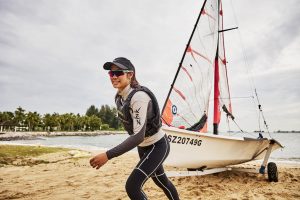

Quieter waters, cleaner air and boats that coastal communities can rely on without paying the price of pollution. This is what a group of National University of Singapore (NUS) students envisions for coastal communities throughout South-east Asia.
Among the team is Lim Jia Yi who is leading the fund-raising efforts and working on the digital twin for Project Roti Proa II. Being part of the nine-month, first-of-its-kind sustainability project to develop low-cost, carbon-neutral water vessels has been an eye-opening experience.
“It has also reminded me of my passion to use tech to create real, positive impact in my pursuits,” says the 21-year-old who is a second-year student at the NUS School of Computing.
Inspired by traditional Polynesian proas, the second version of the hybrid wind- and solar-powered sailboat is being designed to move efficiently while gathering real-time data on speed, endurance and energy use. Those insights could one day help reshape water transport in the region, making cleaner, quieter boats a practical option for communities that depend on the sea.
Jia Yi’s interest in technology was ignited even before she attended university, when she picked up coding while taking computing as an additional O-level subject in secondary school.
“Solving problems through code was something I genuinely enjoyed,” she recalls. “When I realised how powerful technology could be, it sparked a real passion in me.”
That curiosity soon took her beyond the classroom. She was the programme lead with a team of 11 project managers, who advised groups of young Singaporeans on launching their personal tech projects.
Along the way, she often found herself learning just as much – constructing program flows, engaging stakeholders, handling marketing and seeing first-hand how technology could turn ideas into solutions in the real world.
She later co-founded an educational technology start-up with friends, reimagining science, technology, engineering and mathematics education through gamified programmes on platforms such as the video game Minecraft. By turning topics like financial and digital responsibility into interactive experiences, the team reached more than 1,500 students — reinforcing her belief that technology could engage, empower and scale impact.
To fuel her interests, she pursued a diploma in information technology at Singapore Polytechnic, where she continued to build momentum during a year-long internship at the Government Technology Agency of Singapore.
There, she contributed to the development of BookingSG, a nationwide platform that allows Singaporeans to schedule appointments or book government facilities.
Those experiences helped clarify what she was looking for next. “I wanted to forge my own path and bring about positive change – which meant being comfortable with taking risks, adapting quickly and thinking critically about the social impact of technology,” says Jia Yi.
This led her to apply for the NUS Global Merit Scholarship to pursue studies in computer science. She points out that the scholarship has given her the space and support to explore bigger questions and test ideas that push boundaries.
Project Roti Proa II, for example, reflects the kind of hands-on, interdisciplinary projects NUS students are exposed to. Together with her teammates, she now has a chance to apply technology to real-world problems that span borders, livelihoods and the environment.

She was also drawn to the bond-free nature of the scholarship, which allowed her to keep her options open rather than be tied to a single organisation after graduation. Supported by NUS’ strong entrepreneurial ecosystem, she says the freedom has given her the confidence to be “more intentional and fearless in chasing meaningful work”.
As part of the NUS Overseas Colleges (NOC) programme, she applied for an artificial intelligence (AI) engineer internship in Hanoi, Vietnam — despite having little experience in AI and never having lived abroad on her own.
“Solving problems through code was something I genuinely enjoyed.”
– Lim Jia Yi, recipient of the NUS Global Merit Scholarship
The three-month stint at software company Vitex pushed her out of her comfort zone. From building new features on an AI-powered event planning platform to overcoming language barriers, the learning curve was steep.
“It was stressful at first,” she says, “but it showed me that I can adapt, learn fast and handle unfamiliar situations.”
Immersed in Hanoi’s dynamic start-up ecosystem, Jia Yi met entrepreneurs and digital nomads driven by purpose rather than prestige. Hearing their stories sharpened her resolve to think more deeply about the social and ethical impact of emerging technologies.
“In the long run, I hope to build or lead ventures that combine AI, sustainability and community impact,” she explains.
For students considering the NUS Global Merit Scholarship, Jia Yi believes the most important thing is not to box oneself in too early.
“This scholarship gives me the freedom to explore who I am and discover just how far I can really go,” she says. “Growth happens when you lean into discomfort. This mindset now shapes how I approach every new challenge.”