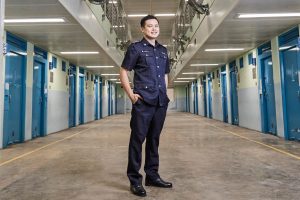
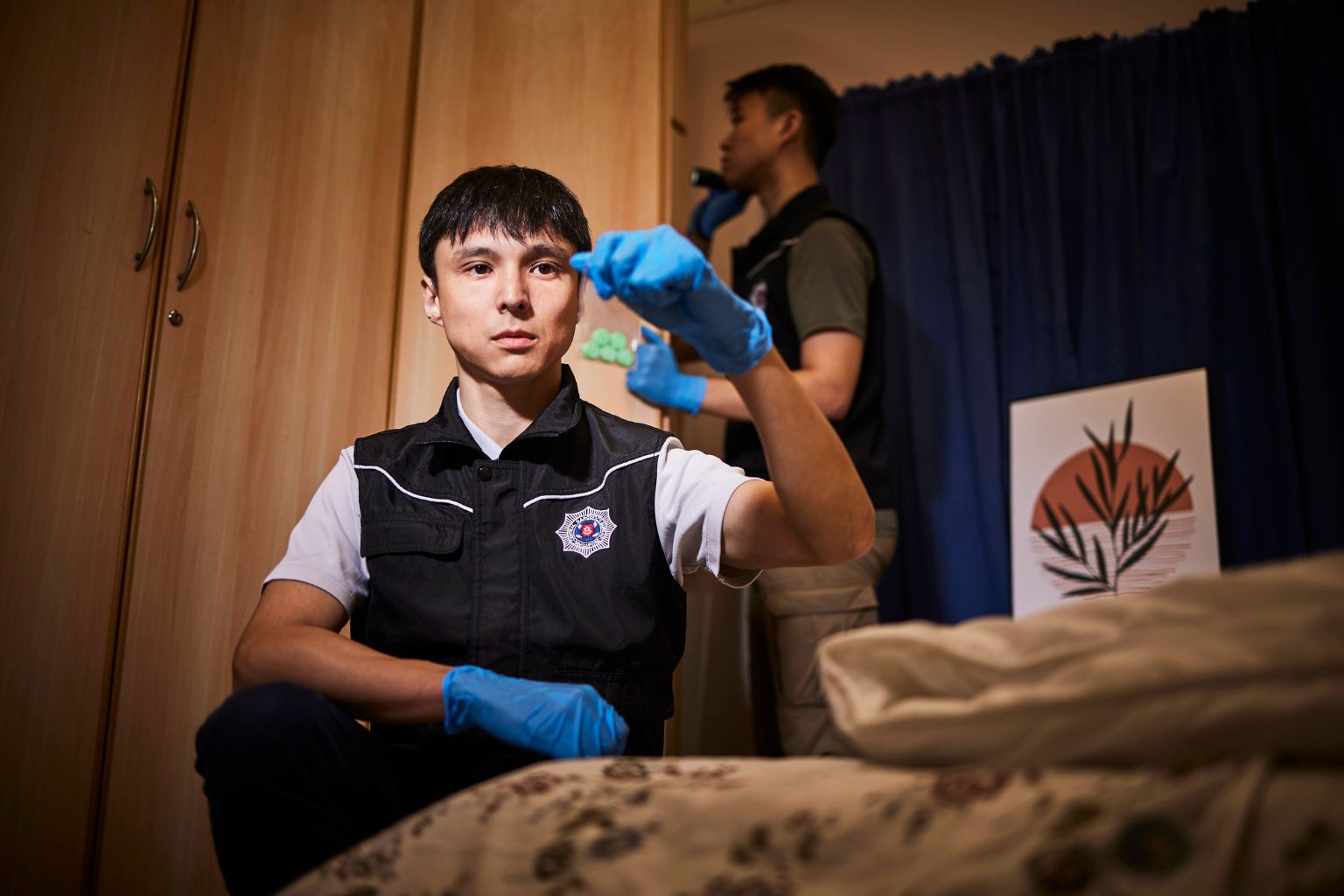
It took eight trained officers to subdue one man who had turned violent – this was James’ first encounter with the destructive power of methamphetamine, or ‘Ice’. It was his first Central Narcotics Bureau (CNB) ground operation since completing a nine-month residential training.
The science behind this frightening display was clear: The drug floods the body with adrenaline while blocking pain signals to the brain. The result is a person who is dangerously out of control.
James knew the harmful effects of illegal drugs, but witnessing their grip on both mind and body is an image that has been seared into his memory. He recalls that the operation in 2022 ran smoothly until his team’s last raid for the night.
The suspected drug offender refused to open his door and stalled for time. When CNB officers decided to break down the door, he bolted out of the flat and charged at them. While the explosive confrontation underscored the unpredictability of James’ profession, CNB officers are trained to handle such situations.
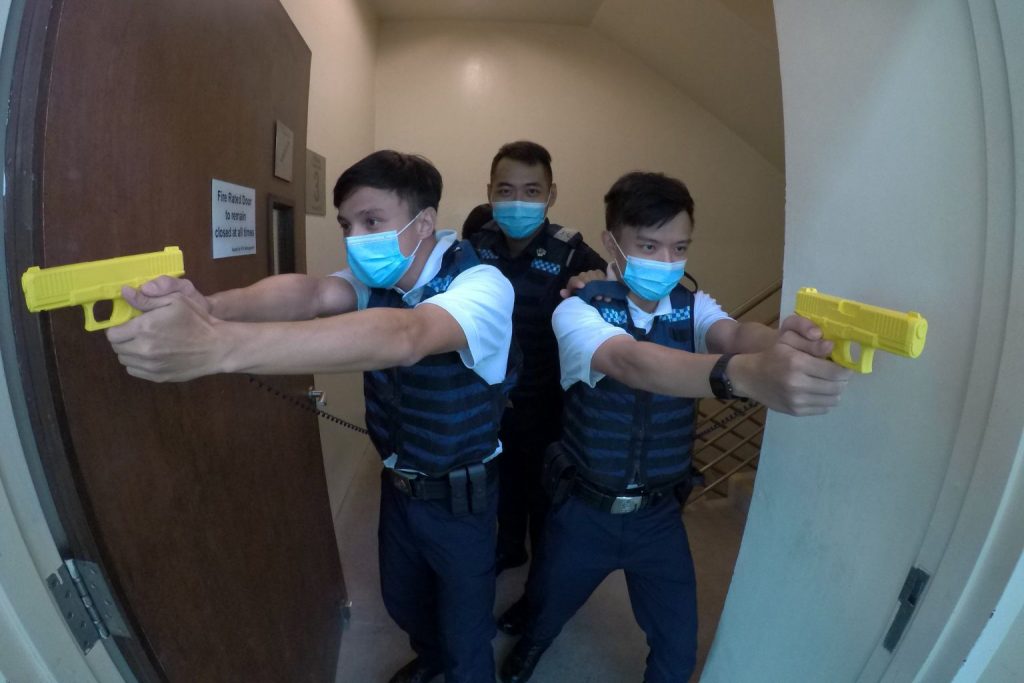
For James, the dynamic nature of CNB’s line of work was what attracted him to join the Bureau. He always envisaged a public service career, and that led him to research the work of various government agencies after junior college.
“The CNB career interested me because the fight against drugs is dynamic and a constantly evolving one – you’d never know what to expect,” says James.
James applied for the MHA Uniformed Scholarship (CNB) and gained insights into the mission of the Bureau through three internship stints while pursuing his studies at the National University of Singapore. Four years into his career now, James is convinced that he has made the right choice.
“There’s always something else that is going to happen. I am always ready for what might come next,” says the 28-year-old.
| Breaking the grip of drugs One of the many ways James is contributing to keeping Singapore safe from the harms of drugs is by helping ex-drug abusers reintegrate into society. “We understand that drug abuse is not easy to overcome, so we focus on giving them a better chance at success,” says James, acknowledging that former drug abusers who are serving CNB Supervision Orders may continue to face other struggles in their daily lives. He had worked on a new programme that CNB piloted in 2023 which redefines how drug offenders are supervised to keep them off drugs. Known as Supervision 2.0, drug offenders who used to have to report to CNB for regular urine tests – usually twice weekly – are now screened once every three months. In the pilot, ex-drug abusers now provide hair samples instead of urine to minimise disruptions to their daily lives as they reintegrate back into society. Hair testing has similar reliability as urine testing while having the added advantage of detecting drug use over a longer period of time. The preliminary feedback on the Supervision 2.0 pilot has been promising, CNB reports. “I am very proud of my work on the Supervision 2.0 initiative because it is a huge and impactful project. The opportunity to work on policies and programmes with direct impact is something that I am glad to have,” says James. |
Since joining CNB in 2021, James has taken on various roles – from ground operations to investigating drug cases and shaping operational policy – thanks to the Bureau’s commitment towards the personal and professional development of their officers.
In-house and external training programmes have equipped him with defence tactics, investigation know-how and intelligence-gathering skills, which he has the opportunity to put into practice in his roles. He has also benefited from the guidance of mentors during his formative days in the Bureau. He now serves as a mentor to others who are junior to him.
“The culture of CNB is such that our officers look out for one another,” he says.

James is also helping to build up the supportive work environment that he appreciates.
“The opportunities to plan and organise meaningful welfare activities for my team not only make the workplace better for everyone but also help me develop my leadership skills. These experiences have built up my self-confidence,” he adds.
In his current role as Senior Executive/Ops Planning and Policy at the Operations Division, James leverages both hard and soft skills he has acquired from his other postings in the Bureau. He is now involved in developing operational policies for CNB, including Supervision 2.0, a pilot programme that redefines how former drug offenders are managed.
Under this initiative, offenders are screened once every three months using hair testing instead of the twice-weekly urine tests. He researched the latest scientific and psychological findings related to supervision issues and drew insights from other Home Team departments, such as the Singapore Prison Service, to inform his policymaking.
“We understand that drug abuse is not easy to overcome, so we focus on giving them a better chance at success.”
– James Stuart, recipient of the MHA Uniformed Scholarship (CNB)
While his tasks in this posting may not be as action-packed as those of his enforcement colleagues, James finds his current role exciting in other ways.
“It’s very intellectually stimulating because it is about dealing with the ‘what ifs’ and the unknown scenarios while trying to foresee what policy changes are needed over a five- or 10-year timeframe to keep Singapore drug-free,” he says.
The global shift in drug policies, particularly cannabis legalisation in some countries, has created new challenges for Singapore. According to CNB, more than half of the new cannabis abusers arrested were below 30 years old, suggesting a growing trend of permissiveness towards cannabis among our youths.
James is keeping close tabs on these trends so that he can be part of policymaking efforts, which can protect lives and families. He has learnt that defending Singapore in the fight against illegal drugs requires both tactical skills and strategic thinking abilities.
His experiences on multiple fronts have shaped his perspective on what makes an effective CNB officer. To aspiring scholars, he emphasises courage in facing the unknown and the value of patience.
“It is good to take a step back and look at things from a different perspective. If you are patient, the way will become clearer to you,” he says.
| About the MHA Uniformed Scholarship If you are passionate, like James, about wanting to safeguard Singapore from the harms of drugs and ensuring everyone can live, work and play safely, we invite you to apply for the MHA Uniformed Scholarship. Select CNB as your Home Team Department of choice and embark on a fulfilling career where you can enforce, educate and engage others for a drug-free Singapore. Upon returning from your studies, you will have access to a structured road map of learning and development opportunities, including operational and staff appointments, with the potential for leadership roles across the Home Team and public service. |
This article is brought to you by the Central Narcotics Bureau.