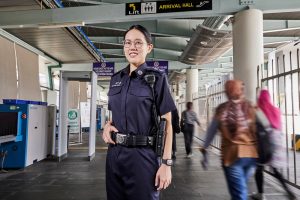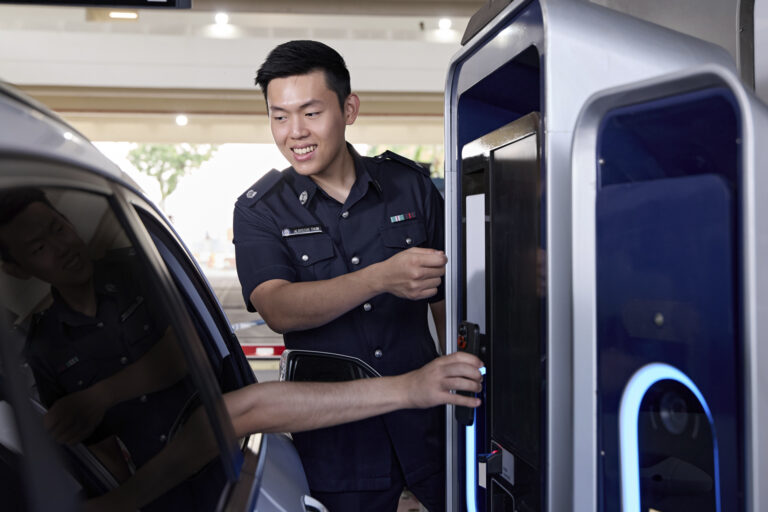
On the eve of National Day last year, Singapore’s land checkpoints were operating at full throttle. More than 558,000 travellers crossed through Tuas and Woodlands Checkpoints in a single day, with surges in car traffic rippling across bus, motorcycle, cargo and lorry lanes.
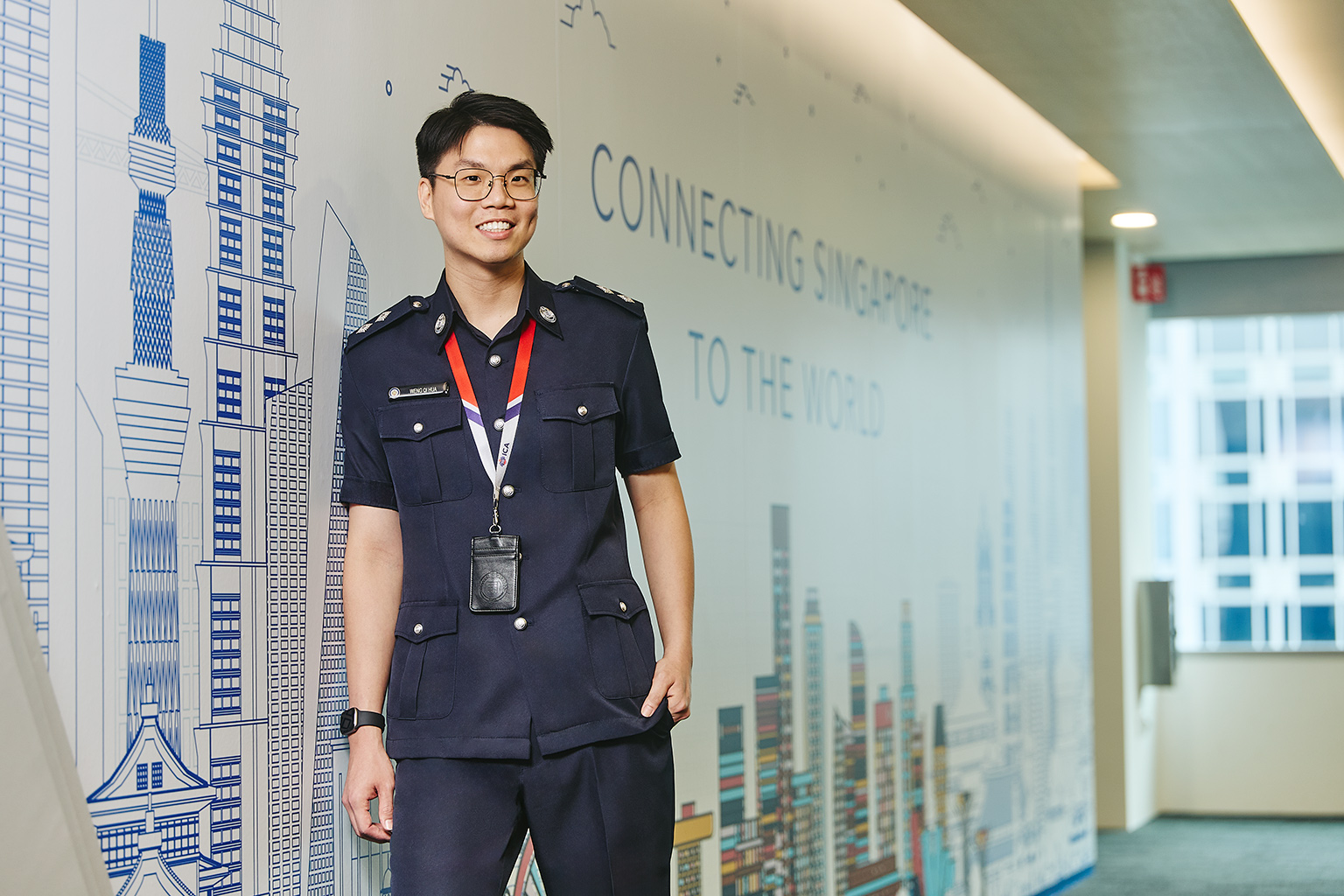
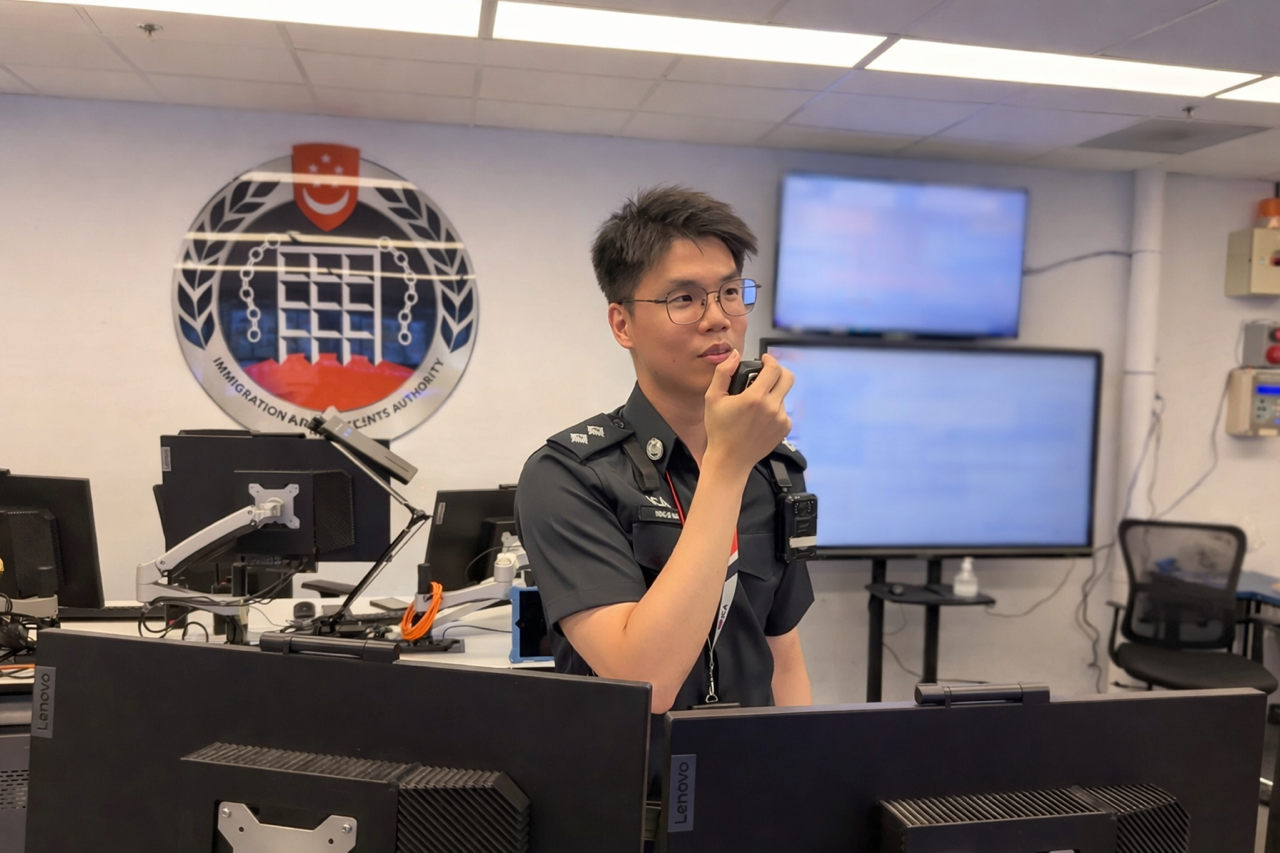
From Tuas Checkpoint’s integrated operations centre, Immigration and Checkpoints Authority (ICA) Inspector Weng Qi Hua monitored the situation in real time, directing manpower to where it was needed most to keep traffic flowing and the borders secure.
How he’s protecting today’s officers for tomorrow – watch this video
“The work was fast-paced and dynamic, requiring me to be adaptable and agile while looking out for incidents and deploying manpower accordingly,” recalls Qi Hua, who was then leading a team of around 12 junior officers.
It was one of many responsibilities the Ministry of Home Affairs (MHA) Uniformed scholar took on after joining ICA in 2023.
Over two years, he rotated through various deployments at Tuas Checkpoint, investigating suspicious immigration cases, managing operational teams and responding to incidents on the ground.
Then, in March this year, came his career pivot. Qi Hua moved from checkpoint operations to ICA’s Human Resource Planning and Development (HRPD) Branch under the Manpower Division. The move marked a shift from being at the front lines to helping shape the workforce that enforces security and protects Singapore’s borders.
As a senior executive, he helps review ICA officers’ jobs and responsibilities while ensuring staff structures keep pace with changing operational needs. His team plans the manpower requirements for new projects and organisational changes, determining the number of officers, roles and skill sets needed to support these initiatives and keep the organisation future-ready.
Technology is changing not only Singapore’s borders but also how ICA officers work, notes Qi Hua. One key shift is officers taking on more complex responsibilities as technology and automation streamline routine processes.
“ICA’s transformation empowers staff units to work more efficiently by leveraging technology such as artificial intelligence to streamline processes,” explains the 28-year-old.
Previously, ICA officers spent much of their time manually checking and stamping passports, while escalating suspicious travellers to supervisors for further checks. Today, under the New Clearance Concept, which uses automation to handle more routine clearance processes, officers can devote more attention to real-time assessment and investigation, intervening when necessary to determine whether certain travellers should be allowed into Singapore.
As officers take on these evolving responsibilities, Qi Hua’s team supports this shift by planning the workforce and skill sets needed.
“I draw deep satisfaction from being able to make meaningful organisational change for people who are working on the ground,” he says.
Qi Hua’s fascination with the role of technology in border security began during his third year at the National University of Singapore, where he studied chemistry with a minor in forensic science.
During an internship with ICA Air Cargo Command and the Home Team Science and Technology Agency, he helped to train an AI algorithm to identify contraband hidden inside parcels and cargo during the scanning process.
“My first real encounter with AI sparked a keen interest in understanding how technology was being adopted in ICA’s operational environment,” says Qi Hua.
When he later joined ICA, he saw that transformation unfolding in real time. Starting with QR code clearance for car travellers introduced at the land checkpoints in 2024, ICA has since rolled out a wave of technology-driven initiatives across Singapore’s land, sea and air borders to make clearance faster, more seamless and more secure.

“I was glad to see initiatives such as the replacement of manual counters with automated lanes, the Automated Clearance initiative, QR code clearance and token-less clearance come to life,” he says.
For a country as open and globally connected as Singapore – nearly 245 million travellers and around 7.7 million containers, consignments and parcels crossed immigration in 2025 – speed and security are equally critical.
Faster clearance, however, cannot come at the expense of security.
ICA’s challenge lies in balancing the need to keep Singapore connected to the world while screening the people, vehicles and cargo coming in.
“Border security is meaningful and impactful work as it contributes directly to the safety and security of the nation,” says Qi Hua.
He finds it exhilarating to witness rapid technological change taking place in border security. For instance, the Automated Passenger Clearance System (APCS), which will be rolled out progressively, will allow drivers and passengers in cars, motorcycles and cargo vehicles to clear immigration without stepping out of their vehicles.
“I draw deep satisfaction from being able to make meaningful organisational change for people who are working on the ground.”
– Inspector Weng Qi Hua, recipient of the MHA Uniformed Scholarship (ICA)
“We’ll likely be the first in the world to be doing something like APCS and that is very cool,” says Qi Hua.
Yet even as automation and AI transform operations, Qi Hua believes there are human skills no machines can replicate.
“Automation and AI are tools that can help us streamline our operations and reduce work on mundane processes,” he says.
“The need for skills that require human instinct – such as spotting and identifying suspicious travellers, and how you conduct interviews – will never change.”
With so much change ahead, Qi Hua has little doubt about the opportunities that await future officers. “It’s an exciting time to join us!” he says.
| About The MHA Uniformed Scholarship Depending on your interests and aspirations, this scholarship will allow you to kick-start your leadership journey as a uniformed officer in one of five Home Team departments: Singapore Police Force (SPF), Singapore Civil Defence Force (SCDF), Immigration and Checkpoints Authority (ICA), Singapore Prison Service (SPS) and Central Narcotics Bureau (CNB). |
This article is brought to you by the Immigration and Checkpoints Authority.