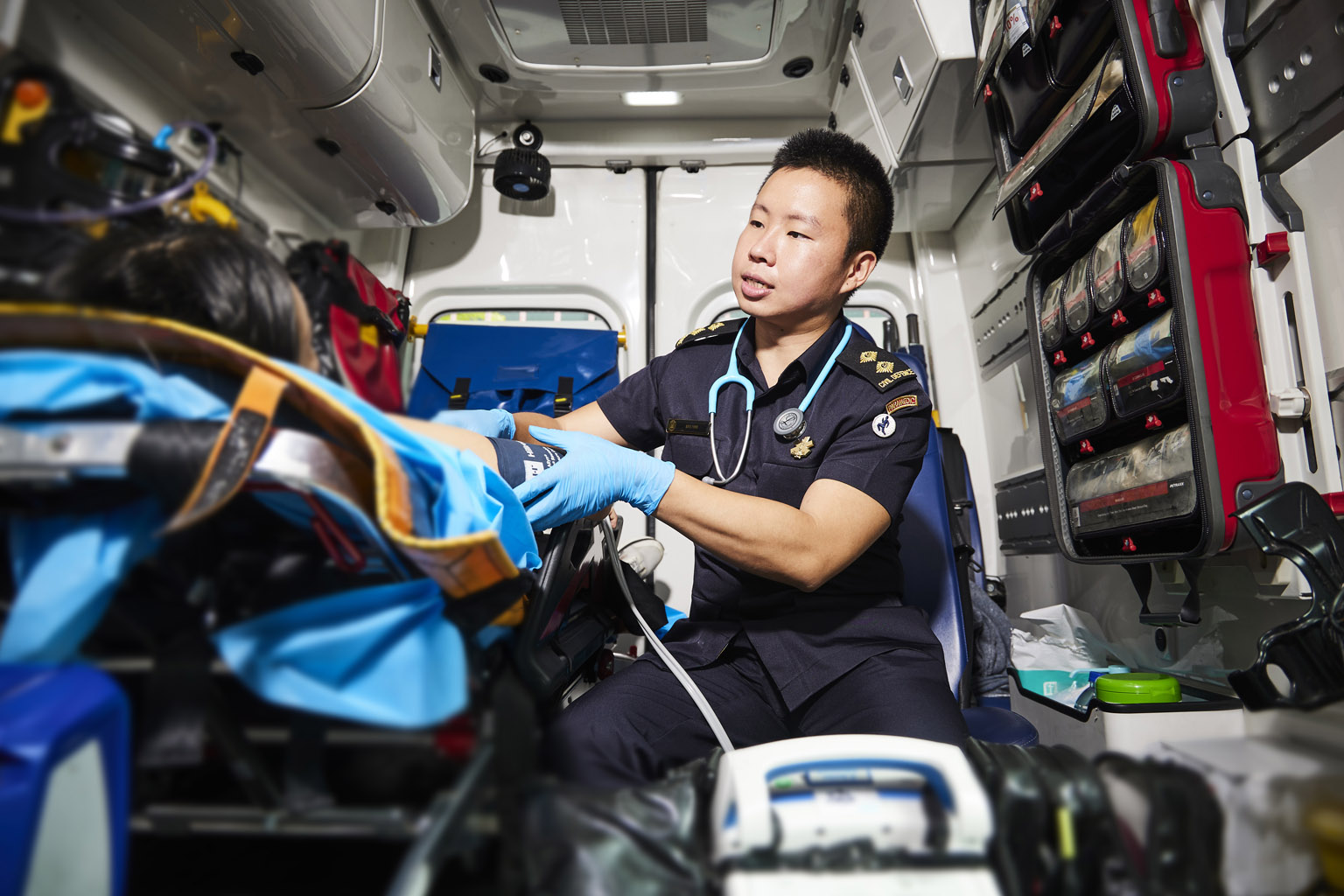
Being a good paramedic means having strong detective skills. Lieutenant (LTA) Max Han can attest to that.
He and his crew once responded to a call from an anxious woman whose friend had not shown up for their regular mahjong game.
When LTA Han and his ambulance crew from the Singapore Civil Defence Force (SCDF) arrived at her friend’s flat, they found the door and gate locked. Through a side window, they spotted an elderly man collapsed on the floor. Firefighters were called in to conduct forcible entry.
Once inside, the team quickly assessed that the man was in a diabetic coma but had no other injuries. After administering intravenous dextrose, the patient regained consciousness.
Further investigation revealed that the man, who was also suspected to be suffering from mild dementia, had forgotten to eat after his insulin injection, triggering a dangerous drop in blood glucose.
As the patient, who was living alone, declined to be conveyed to the hospital, LTA Han contacted the patient’s social worker. He provided an update to the social worker and recommended a reassessment of the elderly man’s ability to live by himself given his cognitive impairments. He also encouraged the man to see his neighbourhood general practitioner for a review of his health status.
A sharp eye for detail is just one of the many overlooked aspects of being a paramedic, says LTA Han.
“It is a very dynamic job that forces you to be on your toes and be well versed in all your skill sets.
“You need to be competent. For example, even though we do not attend to obstetric cases frequently, we will still need to be well prepared to deliver babies.“
Case in point: The 27-year-old has had to help deliver two babies in the past six months – both stressful experiences but also extremely rewarding ones.
“We do go into situations where a life is taken and a patient does not make it, even after trying our best,” he says. “So it is a real privilege to be there when a new life is brought into the world.”
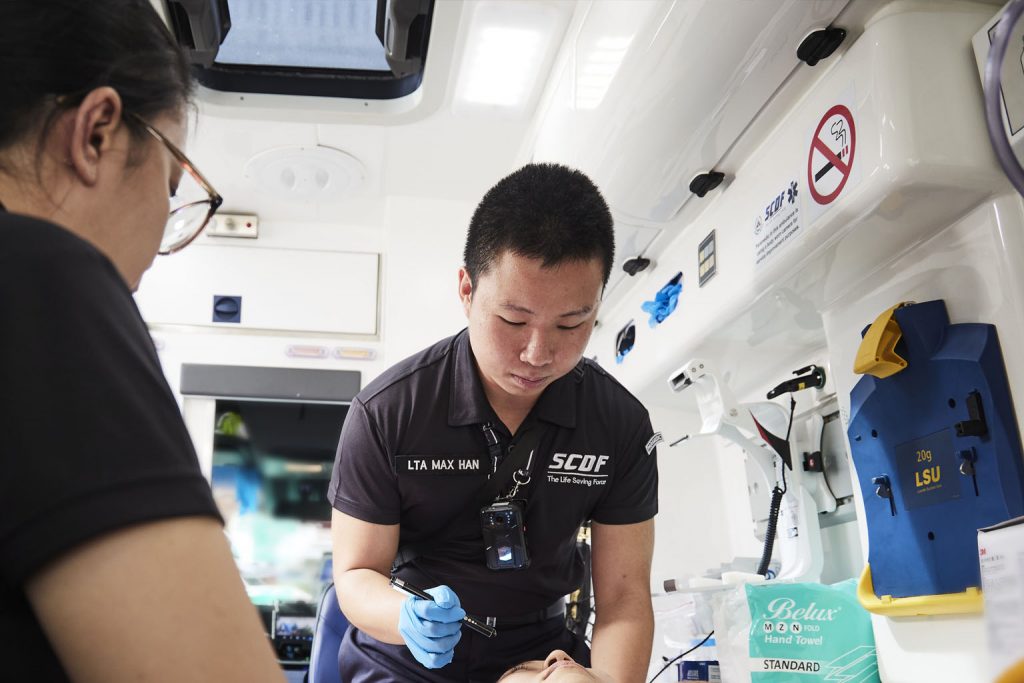
LTA Han is the inaugural recipient of the Singapore Government Scholarship (SCDF – Paramedic Scholarship), offered under the Ministry of Home Affairs (MHA) Uniformed Scholarship.
He first became interested in paramedicine during his national service in 2017, where he spent four months attached to an ambulance as part of his combat medic training.
During that time, he attended to five cases of cardiac arrest, among others. The experience gave LTA Han greater insights into the demands of the job.
“I did consider becoming a doctor, but I was more drawn to the pre-hospital emergency setting – it’s more dynamic and exciting,” he says.
While the fast-paced nature of the work appealed to him, what left a lasting impression was the professionalism and kindness of the paramedics he had shadowed.
”You might not save a life every single day, but you have the chance to help someone when they need it the most.”
– LTA Max Han, recipient of the Singapore Government Scholarship under the MHA Uniformed Scholarship
No matter how critical the situation, they kept their emotions in check and calmly supported everyone around them – from patients and colleagues to bystanders alike.
One paramedic’s words have stayed with LTA Han: “Your job is to be there for them when they need help.”
It is a lesson he carries into his role as an emergency medical services rota commander at Central Fire Station, where he helps lead a team of over 90 paramedics and emergency medical technicians.
Life-or-death situations do not happen every day, and LTA Han is grateful for that.
SCDF receives about 250,000 ambulance calls a year, he notes, though not all are medical emergencies. Some patients may be better served at community healthcare facilities instead of the hospital’s emergency department.
That is why paramedics must be ready for anything – from critical cases to calls that require only observation, reassurance or psychosocial support.
Education is part of this care. Reflecting on the diabetic coma case, he shares a moment that is both humorous and sobering: As they were leaving, the patient offered the team two bottles of soft drinks from a supply at home.
“That is another aspect of patient care we are trying to work on – to be educators for patient health,” says LTA Han. “Many patients do not know what some of their medications are for.”
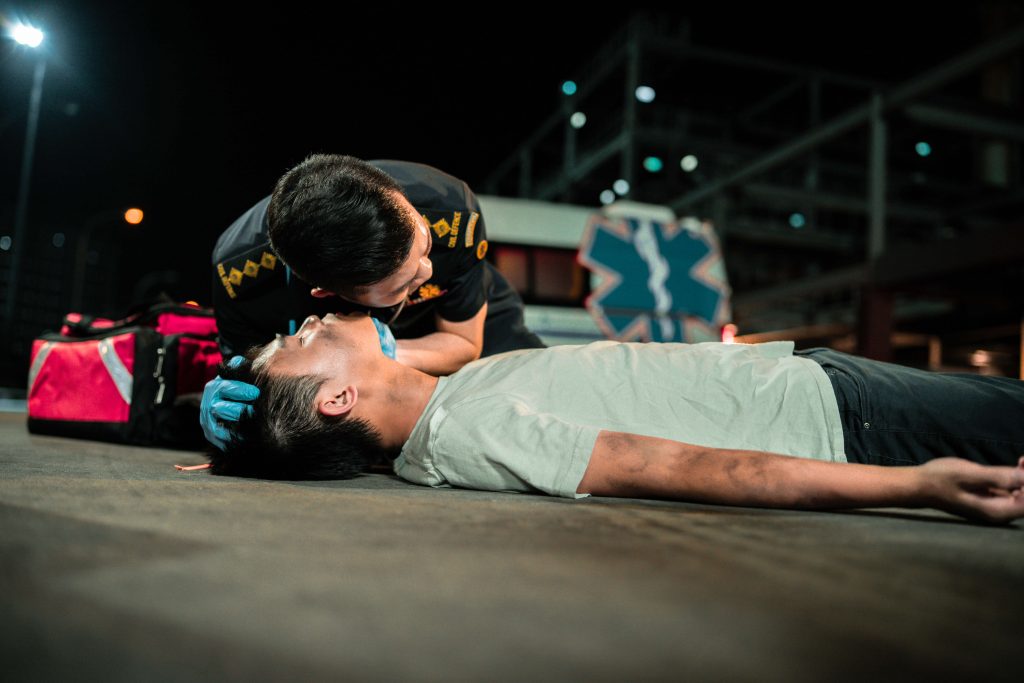
| Trained to tackle any situation Becoming an SCDF paramedic requires rigorous training that prepares officers to handle a wide range of urgent situations – from medical emergencies to rescue missions. Training begins with a comprehensive programme covering medical theory, hands-on skills and emergency response techniques. Paramedics learn to manage a range of cases, including cardiac arrests, traumatic injuries, obstetric emergencies and hazardous environments. Apart from managing challenges unique to an urban landscape, paramedic training is tailored to geriatric-centred care, aligning with Singapore’s ageing population. Paramedics stay up to date through regular refresher courses and continue their professional development with advanced training and simulations to remain prepared for evolving emergencies. Some have the opportunity to be attached to hospitals and emergency services abroad. |
During his paramedic training at Monash University in Australia, where he earned a bachelor’s in paramedicine with first class honours under the scholarship, LTA Han did various attachments with ambulance stations across Victoria, including remote towns like Wangaratta and Yarrawonga. Some cases required hours of travel – or even helicopter evacuation.
While Singapore faces a different set of challenges, they are no less demanding. Paramedics are trained to navigate the tight spaces and narrow corridors of residential flats, manage language barriers and cope with a high number of cases.
To support these efforts, SCDF leverages technology to boost operational effectiveness – including digital tools like the Operational Medical Networks Informatics Integrator (OMNII) tablet, which allows for real-time sharing of patient information to help hospitals prepare before patients arrive.
To LTA Han, being a paramedic is not just about responding quickly – it is about staying calm under pressure, making sound clinical decisions and showing empathy while caring for both the patients and the crew.
“You might not have to save a life every single day, but you have the chance to help someone when they need it the most,” he says.
It is a sentiment that reflects SCDF’s mission – life-saving work that often has a life-changing impact, even in the smallest moments.
| About The MHA Uniformed Scholarship Depending on your interests and aspirations, this scholarship will allow you to kick-start your leadership journey as a uniformed officer in one of five Home Team departments: Singapore Police Force (SPF), Singapore Civil Defence Force (SCDF), Immigration and Checkpoints Authority (ICA), Singapore Prison Service (SPS) and Central Narcotics Bureau (CNB). |
This article is brought to you by the Singapore Civil Defence Force.