At Yuhua Secondary School, a group of Secondary Two students are making pancakes during an after-school session under the Science Talent Development Programme.
As they switch between different types of flour, they observe how changes in composition affect texture and taste.
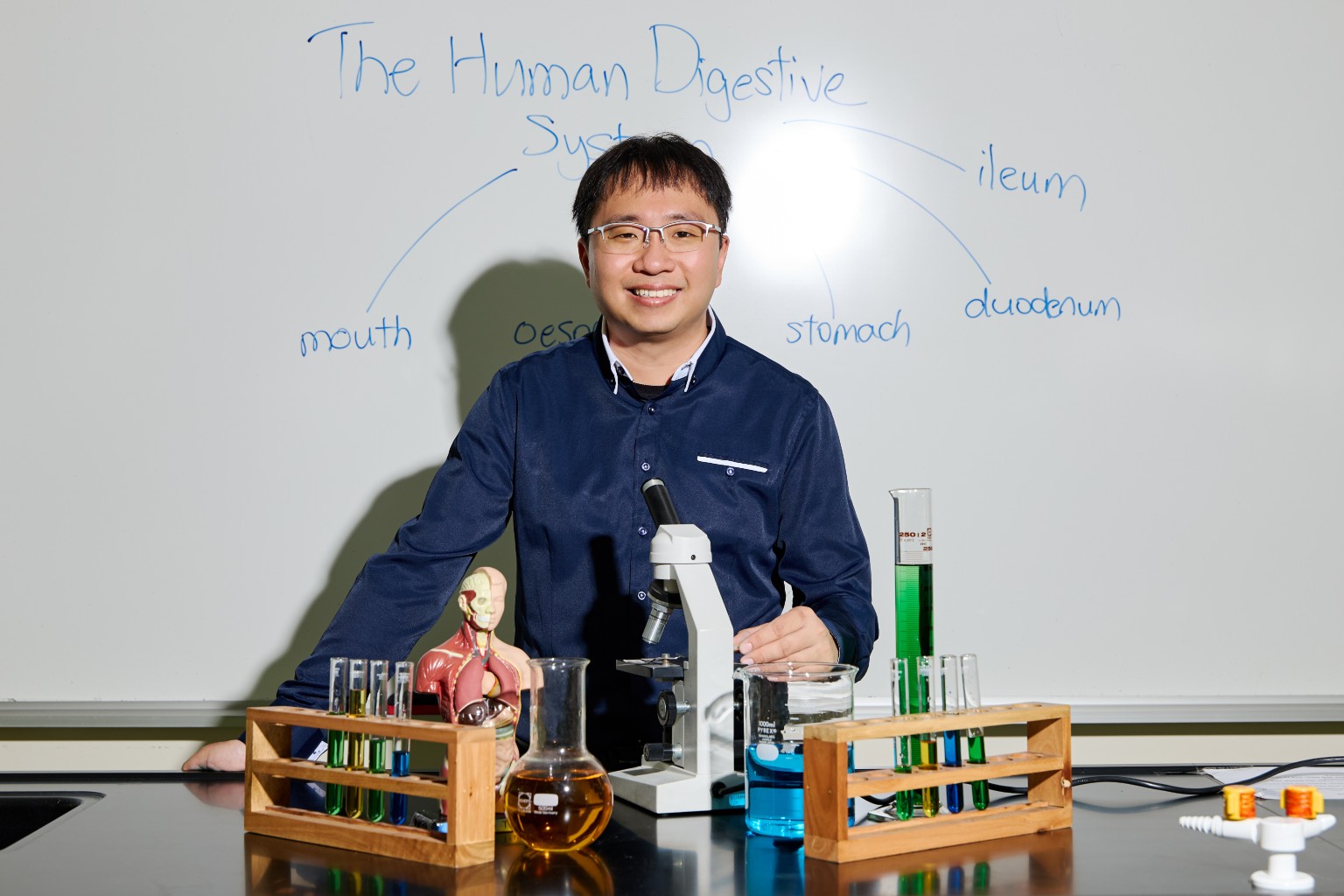
Nearby, a nutrition and food science teacher works alongside chemistry teacher Soh Ming Quan, helping students link molecular interactions to everyday cooking.
In this unconventional chemistry class, students are encouraged to test ideas, discuss observations and draw connections across subjects – reflecting Ming Quan’s belief that learning deepens when teachers work across disciplines to teach and students are given space to explore ideas rather than merely memorising facts.
“Science is not an isolated discipline,” observes the 35-year-old. “It involves understanding how different subjects are interconnected – and applying that understanding to solve problems.”
The programme itself grew out of Ming Quan’s close observation of his students, some of whom showed a strong interest in chemistry.
Hoping to nurture their scientific thinking further, he brought the idea to the school management before working with colleagues to design lessons that blend scientific thinking with real-world applications.
Ming Quan traces his interest in teaching back to his own school days, when he found satisfaction not just in learning chemistry but in helping classmates understand complex concepts.
“What drew me to chemistry was its applied nature and how the concepts are interlinked,” he explains.
“Climate change, for instance, may start with understanding greenhouse gases, but it also requires looking through other lenses such as geography to see how deforestation fuels global warming.”
This curiosity translated into a deeper pursuit of the subject.
Under the Public Service Commission (PSC) Overseas Merit Scholarship (Teaching Service), Ming Quan pursued a bachelor of science in chemistry as well as a master of research with distinction in chemical biology of health and disease at Imperial College London.
During his four years abroad, Ming Quan was immersed in diverse academic and cultural environments.
One experience that left a lasting impression was staying with a German host family in Augsburg over the Easter holidays, where he learnt to build connections across language barriers and cultural differences.
After returning to Singapore in 2013, he went on to complete the 16-month postgraduate diploma in education from the National Institute of Education as part of his teaching scholarship.
Reflecting on his scholarship journey, he says: “The scholarship provided the experiences for me to crystallise my purpose as an educator and live it out in my daily work with my students and colleagues.”
This perspective was further reinforced during an internship at the Ministry of Education (MOE) headquarters, where he saw how strategic decisions and school policies intersect across the education system.
“The interconnectedness of different issues in education left a mark on me,” he shares. “It is really about appreciating different perspectives and working together as one civil service.”
Today, as the head of department of information and communications technology, Ming Quan oversees the online learning and technology ecosystem at Yuhua Secondary School.
“My outlook on my role has evolved from just impacting my own students in chemistry, to empowering my team members to develop systematic learning experiences that benefit a whole cohort or school,” he says.
For Ming Quan, technology is not an end in itself but a way to creatively respond to real classroom constraints in support of student learning.
Recently, he has been exploring how learning analytics and platforms such as the Singapore Student Learning Space – part of MOE’s EdTech Masterplan 2030 – can be used to personalise learning and identify gaps early.
While technology helps surface patterns and possibilities, Ming Quan knows that no computer dashboard can replace the empathy of a teacher in the classroom.
“My overarching philosophy is that teaching is about providing experiences that give learners the confidence and space to develop.”
– Soh Ming Quan, recipient of the Public Service Commission (PSC) Overseas Merit Scholarship (Teaching Service)
When a student struggles, his first instinct is not to reprimand but to pause and understand the situation.
“Rather than asking why homework was not done, I wonder what might be getting in the way,” he explains. “Is it because the student is unsure how to start? Or are there other circumstances, such as a lack of a study routine, that could be causing this?”
Taking the time to better understand his students helps to build trust and allow for more meaningful support.
There is no one-size-fits-all approach, which is why he often begins by getting to know them as individuals. By chatting about their hobbies, Ming Quan also finds ways to explain chemistry concepts in relatable terms.
“If a student enjoys crocheting, I might use cotton yarn to illustrate how molecular structure affects strength and flexibility,” he says.
Besides making concepts easier to grasp, Ming Quan hopes to help students see that learning is within reach – and that, with the right support, they are capable of achieving more than they imagine.
As he sums up: “My overarching philosophy is that teaching is about providing experiences that give learners the confidence and space to develop.”